Blaster Broadcasting: My Second Brain Got a Radio Station
In eight days The Hub grew five AI-generated podcast programmes. The hard part was not making episodes. It was catching what the hosts, and their sources, made up.
Part 23 of the series: Building The Hub
The first episode on my own radio station was Claude and Codex arguing about what The Hub should become.
Neither of them was actually there.
In part 17 The Hub learned to listen: podcasts in a queue, transcripts, summaries. This is the other direction. In eight days in October, it learned to broadcast.
Two teams, one Hub
It started with a brainstorm. On October 10, I asked Claude Code and Codex the same question, separately: what should The Hub become next? Both went off with their own subagents and came back with a top ten. Claude’s list kept circling one weakness: a system that believes things without evidence. Codex’s leaned outward, toward learning and shared agency.
Codex also saved its result under exactly the same filename as Claude’s, and overwrote it. Even my brainstorm had a parallel-agents bug.
The next morning I fed both top tens into NotebookLM and asked for a Dutch debate. What came back was eighteen minutes of two AI hosts going at it, under a title the generator picked itself: Claude en Codex botsen over AI-architectuur. A second episode went through the 28 ideas that did not make either list.
Both were much better than I expected. And they exposed a gap: The Hub could make a podcast, but it had no structure for programmes, only a pile of audio files.
A boombox with cassettes
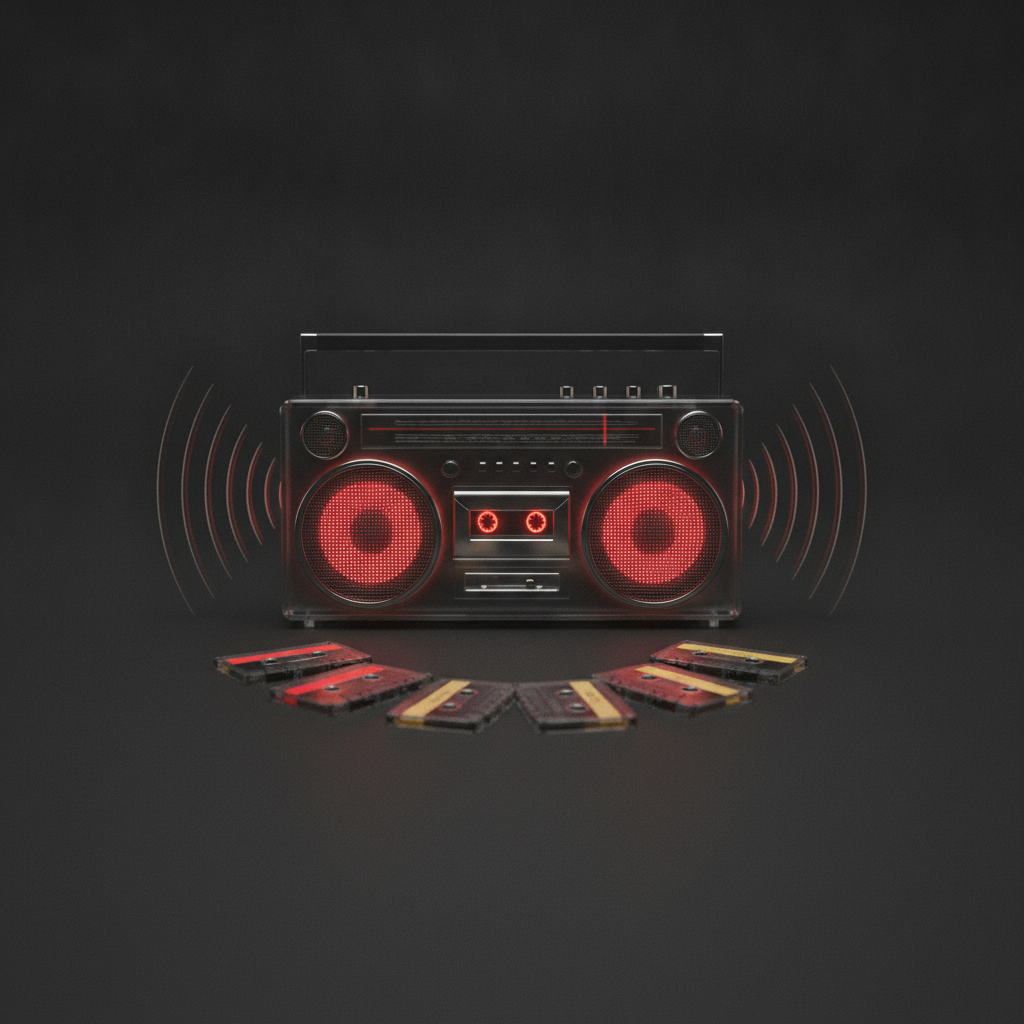
The audio already had a home. My Audiobookshelf library was called Blaster’s Podcasts, after the Autobots’ communications officer: a boombox who broadcasts and carries his crew as cassettes.
The metaphor was already there. Blaster Broadcasting became The Hub’s broadcast division. Every programme is a tape, every episode a track on it:
| Tape | Programme | What it is |
|---|---|---|
| 01 | The Framework | Brainstorms about The Hub, in Dutch |
| 02 | Debrief | The week in The Hub, every Sunday |
| 03 | Level 7 | English deep dives on AI and agents |
| 04 | The Garage | Field prep for events: what others build, held against The Hub |
| 05 | Atlas | Places, peoples and the history that explains them |
One rule kept it honest: an empty channel is noise. A programme only gets a folder once its first real episode exists. Even so, between October 11 and 18 Blaster published 31 episodes, about ten and a half hours of audio.
At that point you need a studio.
The studio is a folder
Every programme lives in Studio/<programme>/ in The Hub: a program.md card with the defaults, a cover, and an episodes.yaml track listing that is the source of truth for everything Audiobookshelf shows. The audio itself stays out of git.
One entry, trimmed:
- number: 1
  slug: twee-teams-een-hub
  title: "Twee teams, één Hub"
  sources:
    - issue:<claude-top-10>
    - issue:<codex-top-10>
    - url:https://a2a-protocol.org/latest/specification/
  sources_rev: a1b2c3d4   # placeholder
  format: debate
  language: nl
  duration: "18:01"
  qa:
    silence_check: clean
    listened: true
sources_rev is the field I would steal for any generated content. It is the git commit whose source files match what NotebookLM actually received. A Google Doc changes in place, so a link tells you which document, not which version. In one of the first reviews, Copilot caught an episode pointing at a commit that already contained a correction the hosts never saw.
The boring parts got scripted. A silence check catches the occasional minutes of dead air (“a long gap means regenerate, never publish it”):
ffmpeg -hide_banner -nostats -i episode.m4a \
  -af silencedetect=noise=-45dB:d=1.5 -f null -
Tags and cover art go in with ffmpeg -c copy, so the audio is never re-encoded. Requests come in through a GitHub issue form, the Request Line, which works from my phone.
The hosts make things up
Then I started actually listening. Properly, with a transcript next to it.
The first Level 7 episode, 57 minutes about why green CI is not proof, opened with a story full of colour: champagne popping, a rollout “to the entire company”, jobs stuck “in the Redis queue”. None of it was in the brief.
It got worse in the details. The brief described a label that cancelled a review run; the hosts turned it into a label that cancelled “the heavy end-to-end rerun to save compute costs”. They quoted a Meta study on generated tests as “only 25% survived, three quarters useless”. The paper reported 75% built, 57% passed reliably and 25% increased coverage. The 25% was a coverage filter, not a survival rate.
Telling the hosts what not to do turned out to be weak. The brief for The Garage’s first episode said, explicitly: open with “This is The Garage” and what is on the bench, no unrelated analogy. Take one dutifully said “This is The Garage”, and then went straight to: “I want you to imagine your phone, right? It’s sitting in airplane mode on a 12-hour flight…” A Level 7 brief said “no invented outages”. That episode opened on a furious client at 3 a.m.
What did work was putting the truth in the sources instead of the rules in the prompt. Every brief now starts with a Facts to get right block:
## Facts to get right (verified 11 October 2026)

- **The entry point is `document.modelContext`.**
  Older demos show `navigator.modelContext`.
- **The Chrome origin trial runs until 30 March 2027,
  not November 2026.**
- **It is a draft, not a standard.**
The second Level 7 episode used that, plus the show name up front and only its own sources selected. Every pinned fact came out right. And for openings, the brief now simply scripts the first line.
So do the sources
The hosts were not the only ones making things up.
For The Garage I used Gemini Deep Research to build background packs. Before trusting them, I had Claude Code subagents check every claim against the primary pages. One report on a web AI summit had about 95 claims; 36 were wrong. A report for a Level 7 episode got 17 of its 62 claims wrong. After a few rounds, a third of the claims being wrong had stopped surprising me.
So the deep-research reports became a supplement, and the primary sources got verified first.
My own notes were a problem too. The Garage episodes compare what others build with what The Hub does, using a short crosswalk of Hub stories. Where an entry was brief, the hosts filled in the mechanism. One line said an Ollama upgrade had silently broken structured JSON output while the pipeline reported success. That is the podcast incident from part 19. On air it became a model that “started hallucinating trailing commas or dropping brackets”. It did no such thing. It refused JSON mode, full stop.
The brief template now says: spell out every Hub link completely, and invent no mechanism, screen or number.
An editor’s note for every episode
That became the routine. Every episode now gets:
- a Whisper transcript, made on Perceptor in about 80 seconds
- a fact check of that transcript against the sources
- editor’s notes in the brief: what the hosts got wrong, and whether it matters
- a retake when it matters
| Episode | Editor’s notes | Outcome |
|---|---|---|
| Level 7 001 | about 8 kinds of error | kept, notes attached |
| Level 7 003 | 9 | kept, opening line scripted next time |
| Level 7 004 | 11 minor, 0 material | kept |
| The Garage 001 | 4 errors in take one | replaced by take two |
| Atlas season 1 (12 episodes) | 72 in total | two retakes |
There is also a reaction field per episode, for what I thought after listening. Most of them are null, and the README is explicit about it: null means nothing was recorded, not that I approved.
Re-recording the summer
The biggest test was a rerun. This summer I had made a NotebookLM series on the United States, for a learning project. In October it became Atlas season 1: a trailer and eleven episodes from one notebook, every one of them fact-checked.
Two failed review and were re-recorded. One about westward expansion called the land wildernis, wilderness, and framed it as empty; the facts were fine, the frame was not. One about slavery told the laws instead of the lives, and wrongly suggested that American slaveholders had been compensated.
And the Silicon Valley episode now corrects the original version on air. The Shockley split was not about germanium versus silicon, and the mouse came from SRI, not Xerox PARC. My old episode had both wrong.
Still on air
A second season of Atlas is already on the shelf. Tightening the prompts between its first and second batch did not bring the number of material errors per episode down, so the next round of work goes into the sources again.
The hosts still sound completely sure of themselves. Now every episode has an editor’s note that is a little less sure.